Monday, February 28, 2011

It’s so Easy in the Big Easy Feb 26-27

Arrived in New Orleans after a pretty short drive from Biloxi. The RV park we stayed in was 2 blocks from the French Quarter, we just parked and did have to use the truck until we left. The first thing we did was take a minibus tour of the French Quarter, the Garden District and the 9th Ward where most of the worst flooding happened after Katrina hit. The first impressions I have is that there are great disparities of wealth and culture in this city. Most of what we saw of the city looked pretty run down, very much like west Oakland. On the other hand, the downtown business district looks new and prosperous, the garden district has some very nice restored homes with million dollar price tags, and then there is the French Quarter which is a Disneyland for adults with questionable tastes.


The 9th Ward is still a ghetto but with one tenth the population it had pre Katrina. There are still vacant buildings waiting to be torn down or reconstructed, many vacant lots where the houses have been bulldozed away, and a smattering of new construction where people are rebuilding. Some of the new building, sponsored by Brad Pitt and Angelina Joliet are quite innovative, using green construction materials, efficient design to reduce heating and cooling costs, and all are elevated at least six to eight feet above ground level. Many are striking in their appearance with interesting roof lines, roof gardens, and sliding shutters to protect the windows. There are probably 30 of these homes. Harry Conick Jr has sponsored a neighborhood for musicians with Habitat for Humanity which is more traditional. Unfortunately they used the Chinese drywall which has high levels of sulfur in it so many of these home have to be rebuilt. After 5 years some progress has been made, but it will take many years for the neighborhood to come back. In addition the public buildings, schools, fire houses and the like are still empty and waiting to be torn down.

Even with all this depressing environmental backdrop, these people like to party. It is a week before Mari Gras, and the party is in full swing. The tourists haven’t arrived in full force yet, but the locals are celebrating. Many houses are decorated in purple, green, and gold.(purple for justice, green is for faith, and gold is for power) Everyday there are parades put on by various social organizations called Krewes. These krewes meet all year to plan for their activities during Marti Gras. They build floats for the parades, make elaborate costumes and provide the funds for the gifts thrown to the crowds watching. (traditionally beads, but we got some condoms thrown to us as well, (still packaged)) Some krewes are very traditional, with long histories, and others are more whimsical. We attended (with Dede) the Celebration of Barkus, a masquerade party and parade for dogs and their owners. All manner of dogs and their owners were dressed in costume. There was a really hot band, food and drink stands, and other vendors selling pet products. Hundreds of people and dogs attended and parade watchers lined the streets waiting for the parade to begin.

The French Quarter is what draws most tourists to New Orleans; its unique architecture, antiquated ambience, jazz, food, and the general festive nature of the place is most compelling. There is a mix of residential, commercial, historic and night club districts within the quarter. The street scene changes from block to block. Some areas can be very crowded with music blaring out the doors and windows, revelers carrying their booze in plastic cups, and one block over it can be very staid lined with high end antique stores or a quiet residential area of 100 year old row houses. While some complain about the excesses of Bourbon St, there are the other neighborhoods that probably look like they did 200 hundred years ago.


One of the draws to the quarter is the food. We feasted on char grilled oysters, beignets, cafe au lait, shrimps, and some of the traditional dishes of gumbo, jambalaya, red beans and rice. While this fare can be had almost everywhere, it just seems tastier in New Orleans.

Friday, February 25, 2011

Feb 24-25 Biloxi Mississippi

Jefferson   Davis' House
Been leisurely making our way toward New Orleans where we have reservations for the weekend. Spent one night in Gulf Shores, Alabama in a small park right on Mobile Bay. Most of the folks are there for the winter and from Michigan or Wisconsin. They all get together for a campfire and cocktails most evenings and they invited us to join them. It was pleasant to socialize and swap stories. We got our lead for a good place to stay in Biloxi from one of the folks.


Our tax dollars at work


We are staying in Cajuns RV park here in Biloxi, right next to the Gulf of Mexico. It was foggy when we first got here so we couldn’t see much, but today it is clear and we can see the gulf and all the vacant lots along the shore line. It’s been 5 years after Katrina, and while there are few signs of broken buildings or uprooted trees, there are a lot of vacant lots and building foundations (mostly slabs) along Beach Boulevard. It looks like the devastation went in about two city blocks inland from the beach. Some of the tree stumps left by Katrina have been made into sculpture by local artists. The roads have been restored and new palms planted and a number of historic homes have been restored, including Jefferson Davis’ home.


Beauvoir, the Jefferson Davis Home and Presidential Library, is maintained and operated by the Sons of Confederate Veterans, a group that must be pretty long in the tooth by now. I had to promise Patsy, that given that I am a white, liberal smart ass from Berkeley, I would keep my mouth shut and keep my opinions to myself while on the premises.

The actual tour of the house was totally non controversial, Davis moved into the house well after the civil war in 1877. The house had been built in 1852 by James Brown, a plantation owner, and had fallen on hard times after the civil war. Two or three owners later had fixed it up and allowed Davis to purchase it for a nominal amount as he was not wealthy after spending a few years in a federal penitentiary. He obviously had benefactors who supported his lifestyle on this 87 acre spread. After Davis died, his wife, Verina kept the property until 1903, when she sold it to the Sons of the Confederate Soldiers who turned the property into a confederate old soldiers home. It operated as such until 1956. Those had to be some very, very old soldiers by that time! The house and grounds were then converted to a museum and presidential library. Through the years and many hurricanes, only the house and a couple of out buildings remain. Katrina did major damage to the house, it took over three years to restore the house to its original condition. The restoration work included putting on a new roof and restoring the fresco wall coverings which resemble kind of a painted rococo architectural style. Somehow most of the original furnishings survived or were able to be restored.
President Davis

The only controversial part of the tour (from my point of view) was a little movie they showed about Davis and his devotion to the Confederacy. The part about the negro servants who loved their masters so much that they fought for the Confederacy and felt so sad after the war was lost, was too much for me!

It’s on to the Big Easy tomorrow.

Tuesday, February 22, 2011

Feb 19-22 Beginning the Home Stretch

Sunset over the 'Glades
Friday February 19th was the first day of the trip back home. Our goal now is to arrive in Ben Lomond no later th an the first of April. Of course we want to see some sights along the way: New Orleans around Marti Gras, Graceland, the Clinton Presidential Library, the Grand Canyon come immediately to mind, and I’m sure there will be others as we come across the country. We are talking with Liz and Stef about meeting up with them in San Diego sometime in March. My main concern is to avoid any serious weather. It is still winter in most of this country even though we hardly realize it here in Florida. It been mostly shorts and T-shirt weather for us since the first of the year. Those cold days in Jacksonville around Christmas are a distant memory


After being in one place for so long it is kind of hard to get our heads around travelling most days. We left the Keys two days early to give ourselves plenty of time to get to New Orleans by the 26th of Feb. We don’t have a lot of plans traveling up the west coast of Florida other than stopping to eat some Apalachicola oysters and spend some time on the “sugar” white sand beaches in the “Red Neck” Riviera.

Our first nights stop was at the Chokoloskee Island Park at the northwest end of the Everglades. On the map it looked to be interesting being almost right in the park, it turned out to be a very busy place. Fishermen, fisherwomen, boaters, and kayakers were coming and going in a constant stream. Our narrow site was right across from the boat ramp so we were in the thick of it. Boats were being launched and retrieved all afternoon with trucks and trailers lined up awaiting their turns. I was lucky enough to back the trailer into our site during a lull in the traffic. So much for the quiet, peaceful gaze across the mangroves. It turn out to be a popular spot for snowbirds from upstate New York who were into fishing of course. There was also some kind of kayak event going on so I’m sure that added to the festivities as well.


The next day we drove up through Naples, Fort Myers and stopped in Venice. Not a long drive, but we did have another GPS adventure, not a major miss direction but we did get a tour of some Venice neighborhoods. Many of these RV parks claim to be in cities or towns that are popular destinations, but in fact are not really in the city limits. So when you type in an address, but with the wrong city the GPS cannot find it. So we had a unexpected tour of a few miles until we confirmed the exact location with the park staff.


The next day we left the “retirement towns” and headed into the more hardscrabble regions, miles and miles of swamp land giving way to pine forests. We stayed at the KOA in Perry Florida, an inland mill town. In the KOA literature it mentioned that if you should smell something that might make you think of rotten garbage or sewage, not to worry, it’s not coming from your trailer, but it is the “smell of money” coming from the paper pulp mill which is the main employer for the people of Perry. Needless to say, we moved on the next morning.

White "sugar" sand


We drove west to the coast and stopped for lunch at Apalachicola, famous for its oysters. A historic old town not unlike a lot of the towns on the Oregon coast, a place that has seen better days but is hanging on by catering to the tourist dollar. We had a a great oyster lunch at the local bar and grill. We ended up the day in Mexico Beach, a town 3 miles long, started by developers in the 50s to take advantage of its beautiful beach coastline. They developed the town to allow no big high rise building and chain stores or restaurants. It is all pretty much down home here, and mostly caters to a southern crowd. The southern drawls here are thick. Lots beach houses, a few condos, a nice little fishing harbor and pier for those without a boat. A half a dozen eateries, one grocery and a few T-shirt shops and that’s about it. Just west of here is Tyndall Airforce Base and you can see and most definitely hear the jet fighters scream across the sky.

Snowbirds on the beach

Thursday, February 17, 2011

Key West and Fort Jefferson Feb 14-17

Key West 

We moved further down the keys to mile marker 20, Sugarloaf Key, to be closer to Key West, where we wanted to explore and be able to take the day trip to Fort Jefferson.  We are staying at Lazy Lakes RV park, which pretty much describes the place.  It has two manmade lakes, probably the result of quarrying for limestone, and most of the trailers here are permanent indicating to me that the folks live here year round.  It is not close to anything, the nearest stores being in Key West 20 miles away, but there is a funky old restaurant, Mangrove Mary’s, across the highway. (great seafood)

We spent a day in Key West, where I got to visit Mel Fisher’s museum.  Mel was the treasure hunter who found the Nuestra Senora de Atocha, a Spanish galleon, in 1985 with millions in treasure off Key West.  The  State of Florida sued him for possession of the entire treasure locking up the booty for seven years in the county jail, while Fisher sued for his right of possession all the way to the Supreme Court.  (He won)   His family is still recovering sunken treasure from this and other wrecks off of Key West.  His favorite quote “Today’s the Day”  It took him 16 years to find the Atocha.
Harry relaxing in Key West

My other Key West visit was to Truman’s Little White House.  Until  1974 the Navy operated a submarine base right in downtown Key West.  On that base was the commandant’s quarters, which President Truman visited at the invitation of Admiral Nimitz.  The base was between commanders and the house was empty.  Truman loved the place so much for its peace and tranquility, that he visited the place many times during his presidency.

 The building is now a Florida state park, and the base itself was sold to an Indian (India indian) real estate developer from Boston.  At any rate the house has been restored to the condition it was in with all the furnishings it had when Truman stayed there.  It is a tribute to a courageous president who made some very tough calls during difficult times.  The “Little White House” was also used briefly by JFK during the Cuban Missile crisis and other presidents for R &R.  Even though it is a state park now, and not a federal facility, if you are a former president, you can make a reservation.

Our primary reason to stay close to Key West was to be able to take the day trip to Fort Jefferson.  The trip starts at 7:00am at the dock, and ends later the same day at 5:30pm.  Fort Jefferson is located 70 miles west of Key West and you get there by a high speed ferry or by seaplane.  We opted for the ferry, which takes two and one half hours to get there.  The ferry is two hulled catamaran and goes along at 26 knots.  While the trip was somewhat bumpy, no one got seasick as the seas were pretty smooth.

Fort Jefferson is pretty much in the middle of nowhere on a spit of sand not much larger than the fort itself.  It was started in 1846 on the site of a light house that was built in 1825.  While it is located in an area of treacherous reefs and sand bars, but it also has a couple of areas where ships could anchor and be protected from perilous seas.  The fort was built so no other nation could use the location as a staging area for a naval assault against gulf shipping or attack on land.  It is the largest brick structure in the western hemisphere.   It has over 16 million bricks,  so heavy that it began to sink into the ocean even in its early stages of construction.  They built on it for 30 years and never finished it.  There are gaping holes in the walls that were never bricked up, the walls being 8ft thick,  it takes a lot of bricks to fill in the gaps.  It was intended to house 410 cannons, with a range of 3miles to discourage a naval attack.  In actuality, the fort has never been attacked and was declared obsolete as a military facility in the 1880s.
 
Its primary use became that of a military prison.  Soldiers, tried as deserters, were imprisoned here to be used as laborers to build the fort.  The most notable prisoners were the Lincoln conspirators including Dr Samuel Mudd, the doctor who set John Wilkes Booth’s leg after Booth assassinated Abraham Lincoln.  He and the other conspirators were pardoned in 1869 by Andrew Jackson.

Today Fort Jefferson is a national park and a wildlife sanctuary.  The park is 48 square miles, 99% underwater.  What little land there is (other than the fort) is dedicated to the birds and the turtles that lay their eggs in the sand.  The fish are protected as well as there is no fishing permitted in the park which is marked with boundary buoys and patrolled by heavily armed park rangers.  (Why do park rangers carry side arms, tassers, mace and billy clubs, to manage a bunch of senior citizen tourists on a day trip to a wildlife sanctuary?)

We took the guided tour of the fort walking over the three storied fort exposing ourselves to some very nasty, most definitely fatal falls should you lose your footing near the edge of the building.  This place most resembles a deteriorating building site with no OSHA oversight.   They are not kidding when they warn about “crumbling bricks.”  We were going swim in the lagoon as it was advertized as a great place to snorkel and see lots of fish, but the reports of those who did snorkel there wasn’t much to see.  There are no facilities for tourists on the island like water, rest rooms and the like, (those things are provided on the ferry)  it seemed too much of a hassle to get wet for the sake of a swim, to have to sit around in wet bathing suits and have sticky, salty skin for the 2 hour ride back to Key West.

All in all we were glad we went.  It is a colossal building in the middle of nowhere with some interesting history. We saw lots of birds in their nesting area and few fish.  The boat ride while a bit long, was smooth enough so we didn’t get seasick.  It is truly at the “end of the road,” where not all that many get a chance (or have the desire) to visit.   
Unfinished section of wall

Tuesday, February 8, 2011

Wild Life in the Keys February 2-8

Our first Manatee sighting


There is a lot of wildlife on the Keys both above and below the waterline.  We had our first manatee visit a few days ago.  We were beginning to think that they went the way of the flamingo.  The manatee swam slowly by and stopped for a spray of fresh water from our hose on the dock. I’m told that you’re not supposed to water the manatees, but it is clear that they like to drink it.  It hung around long enough for all us trailer park folks to take its picture and then moved on up the bay.

I have been diving in the Penenkamp underwater reserve, an underwater sanctuary that has forbidden fishing for over fifty years in the reef areas.  I have never seen so many fish that are so very tame that you can swim right up to them and swim through the schools of fish without having them run away.  The majority of the fish are somewhat small as this area is a “nursery” for many species, but there were some big guys as well: 4ft moray eels, 5ft barracuda, 6ft nurse sharks, and some big manta rays and turtles.  The diversity of fish here is amazing, lots of tropical colored fish, “lobsters”, eels, rays, turtles, and dolphins.

On land, we have crocodiles, alligators, iguanas, snakes, deer, birds, dogs, cats and people.  While it is very rare for people to be injured by the crocs and alligators, it does give one pause to run into one of these critters when walking in the woods.
 Great white Heron

The birds here are quite impressive.  One of the most prevalent are the pelicans whose graceful glides along the shore are pleasing to watch.  There are a number of water birds, here that swim underwater, only their heads popping up occasionally to the surface for a breath of air. After their swim, some sit in the trees with their wings spread out to dry in the sun. Anhinga’s have no oil in their feathers and have to dry their wings out before they can fly very far.  Ibis walk on the beach poking in the sea grass with long beaks looking for minnows to eat.  Giant herons and egrets stand stock still in shallow water or on the banks waiting for the next unawares fish to swim by.  Most of these birds seem to be unafraid of people and only grudgingly move off if you come too close.  The pelicans might even give you a nip if you don’t watch out. 
Three Birds Spoted  in the Gumbo Limbo forest


There is a bird sanctuary here on Key Largo which is privately run and funded by donations.  It is a funky establishment, the cages for the birds are spacious, but built out of donated bits of 2x4s, plywood, and chicken wire.  The help is mostly volunteer and they seem to be very attentive to the birds.   Many of the cages look to be on the verge of collapse.  They house the injured birds that are here to recuperate.  They have a few owls and hawks, but seabirds by the dozen.  There must be a couple of hundred pelicans  that are not patients but just hang out here for the free food.  The sanctuary is in a mangrove swamp next to the bay so it is a natural habitat for all these birds to hang out at. 
Lunch at the Big Chill

Speaking of wild life, Bobbie and Jackie came to visit us for a week.  We had a great time visiting the Everglades, airboat rides, and hanging out in the local establishments.  The weather turned warm and we all enjoyed some tropical days.  Pats took them to Key West for a couple of days, where they told me that they spent all their time in “museums”.   With all the fun and games over on Duval St. I don’t think they spent all their time in stuffy museums.  Anyway, we all had a great time, and sent them home today back to the cold stark reality of a northern California winter 

Friday, January 28, 2011

Jan 28th Still Hangin’ Out

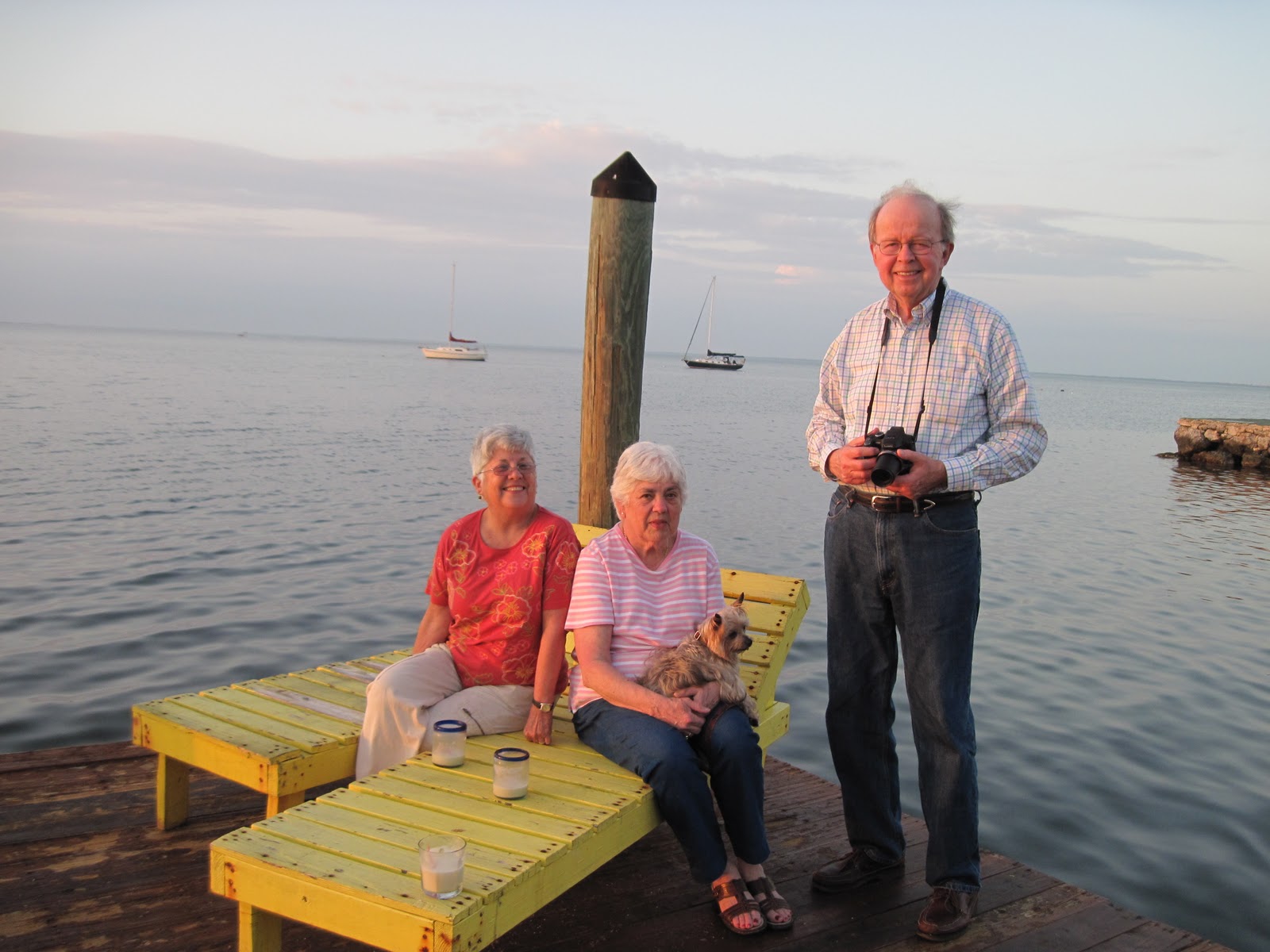
Happy Hour on the dock
Not too much goin’ on, but I guess that is why we came here. It has been a mix of weather more cold and wind than we would like, but we have had the odd warm day as well. By cold we mean it has not gotten above 70 degrees. Any temp below that seems a bit chilly to us. It is amazing how fast one can acclimate in this climate. It will be an adjustment once we get back into the colder climes.


We have taken more day trips. Ben and Dot were down for a few days and we toured the upper keys. We took a glass bottom boat trip to the reef one day and got to see lots of manta rays and other reef fish: barracuda, grouper, wras and parrot fish.

Everglades Air Boat

We went up to the north end of the Everglades and visited a Miccosukee “Indian village” (tourist trap), and we took an air boat ride into the glades which was really a lot of fun. The guide book we have doesn’t think the air boat concessions are particularly ecologically correct, but they are a lot of fun and they don’t seem to bother the wildlife. The gators and birds pretty much stood their ground as we went whizzing by. This part of the Everglades is pretty much a sea of grass standing in a few inches of water. Occasionally there are “hammocks” small islands of hardwood trees that have a bit of soil and are above the water. The Miccosukee Indians hid out in these hammocks to escape being deported to the west in the early 1800s, and lived in these bits of land until as late as the 1950s. The guide said that this area is actually a very wide river that flows from central Florida to the coast through the Everglades.

Sea of Grass


We took another trip to Key West to check out RV parks and places closer to Key West than we are now. It is about a two and half hour trip from Key Largo to Key West and we want to check out the lower keys while we are here. We found a park about 20 miles from Key West that we could get into mid February for a week.

While we were there we stopped by the marker designating the most southern point of the US. ( I don’t think they’re counting Hawaii) Everyone in the neighborhood is cashing in on the location, advertising “the southern most house”, “the southern most hotel”, “the southern most gift shop” as if “southern most” was an attribute that would that should be highly prized by gullible tourists.


"Southern Most" Gullible Tourist


Saturday, January 15, 2011

Jan 15 Hangin out in the Keys

Toothy Smile
For the last two weeks we have had a mix of weather from hot (80s) to cold (50s) and windy. Needless to say the temp pretty much dictates what you want to do around here. We have had two fronts pass through and we had to take down Paddy O’Room each time due to the wind. We getting pretty good at taking the room down and putting it up again in just a few minutes.


On the warm days we have hit the water. There is an underwater park here where one can swim off the shore, kayak in the mangroves, or take a snorkel or dive trip to the nearby reef where you can see fish and corals. We snorkeled off the beach where they have arranged about a dozen cannons and a ships anchor to replicate a sunken ship circa the 1700s. It is in about 6 feet of water so it is easy to see, and it gives the local fish someplace to hang out.
Mangrove roots

On another day we rented a Kayak and explored the mangroves. The mangroves grow in salt water and are the basic building blocks of these islands. They grow in such a way as to create little islands, with narrow waterways or passages along the shore. The park has marked the channels for use by canoe or kayak so you don’t get lost in the maze. The water is about 6 to 8 feet deep and totally clear. Lots of fish can be seen in the mangrove roots and in the channels. When we went we pretty much had the whole place to ourselves, which made it very peaceful and quiet gliding down the narrow channels. I don’t I would want to be there with a crowd of kayakers running into each other and all the noise they would make.

We took a snorkel trip on a dive boat out to the reef. The reef is about 3 miles off shore. To get to the ocean we travelled through about a mile or so of mangroves through narrow channels marked for boat passage. Once out in the open ocean the depth was about 10 feet deep, but with many shallows in places. Out on the reef the depth was about 25 ft in the deep areas and about 2 feet deep in the shallows. On the day we went out the wind was blowing and the seas were a bit choppy. Not real great for snorkeling, but ok for the divers who go below the surface. Pats and I were able to get out on the water and paddle around for awhile. We saw a lobster, parrot fishes, a moray eel, lots corals and other fish. We were both a little sea sick from all the bobbing but it was worth it to get out to the reef. I would do it again on a calmer day.
Walkin the Dog

On the days when we just hang out, we walk the dog, take bike rides through the neighborhoods, read, nap, wander over to the dock to watch the sunset and chat with our neighbors. Pretty low key existence. It seems like most of the snowbirds here are from Michigan. Many have come to winter in Florida for many years. We are the only “westerners” that we know of.

We have taken two day trips, one to the Everglades and one to Key West. The Everglades park is only about 30 miles from Key Largo back on the mainland. We went to Flamingo, which used to be a town, but is now the end of the road in the park. There remains a dock, a National Park Visitor center and an RV park. There used to be a lodge where you could stay but it got flooded in the 2005 hurricanes. From Flamingo you can take a boat tour into the park via a manmade canal that eventually connects to Whitewater Bay to the north. Along the way you can see alligators, crocodiles, and other wildlife. There is a naturalist on board who explains the ecology of the area and identifies and plants and animals along the way.
Anhinga drying its feathers

In another area of the park, Royal Palms, there is a slough filled with wildlife that resembles a zoo. These animals are there I guess cause there is no better place to be. Alligators by the dozens, turtles, all kinds of birds, egrets, ibis, anhinga, wood storks, and turkey vultures. Ironically there are no more flamingos found in the Everglades, it seems they were eaten by the early settlers who lived in the glades at the turn of the last century. They still exist on some of the islands in the Bahamas, and at Seaworld in Orlando.

We took a day trip to Key West, 103 miles west of Key Largo. This is one of those trips that you need to enjoy the journey as well as the destination. The Overseas Highway (US 1) is mostly two lane with a 45 mph speed limit. It crosses 36 Keys on bridges ranging from 50 ft to 7miles across. The road bed is built on the remains of a rail line built by Henry Flagler in 1905. It is quite scenic but not very fast. Many of the keys are very narrow and it is hard to differentiate what is land and what is mangrove swamp. What is amazing is the amount of development on these little islands. Every coastline seems to be lined with houses and boat docks. In a place prone to hurricanes, the amount of investment in real estate, (where hurricane insurance can no longer be purchased) seems to me to be another disaster waiting to happen.
The road to Key West

Key West is stuffed to the gills with people. There is a Naval Air Station here, an international airport, a cruise ship port and a huge tourist area. It has historical buildings: Truman’s “White House”, Hemingway’s house, and other old buildings of the “conch” era. “Conch” being the term for things historically “Key West.” It is also the most southern place in the continental US, only 90 miles from Havana. The main tourist area Duval street is a mix of t-shirt shops, restaurants and bars with a tropical theme, with pirates and eclectic art thrown in. Sort of “Were at the end of the earth, so let’s party!”